Olungu
Intentional Digital Use, Attention, and Well-Being: What the Research Actually Shows
Intentional, goal-directed technology use predicts stronger attention and higher well-being than passive use — screen time alone explains almost nothing.

Founder of Olungu and a software engineer with over 10 years of experience building technology products. He writes about productivity, focus, behavioral psychology, and evidence-based strategies for achieving goals and doing deep work.
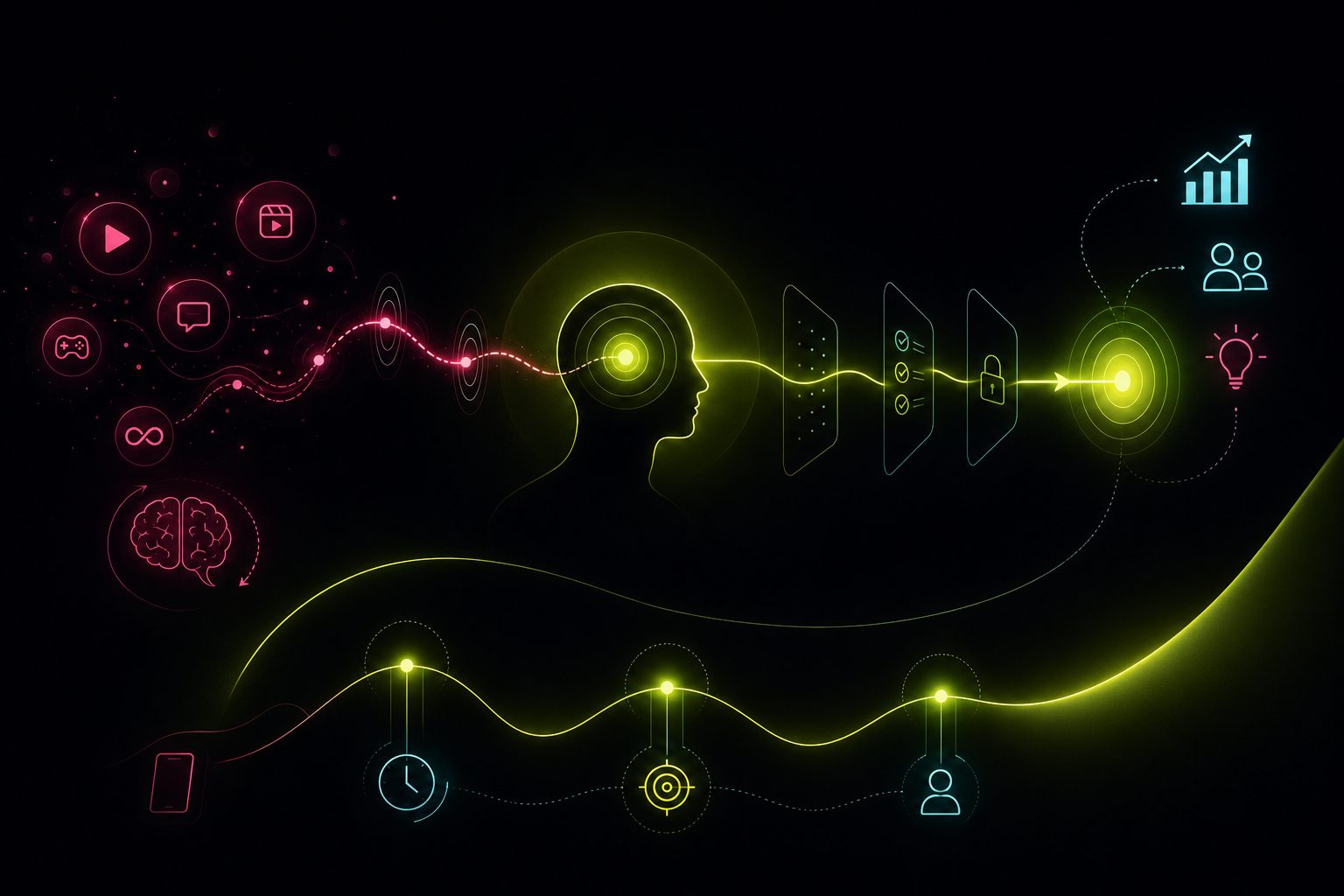
How you use technology matters far more than how much of it you use. Research published in Scientific Reports found that intentional, goal-directed technology use positively predicted both attentional control (β = 0.42) and psychological well-being (β = 0.37), while passive, habit-driven use showed negative associations with both — and these effects held even after controlling for total screen time.
Intentional, goal-directed digital use predicts stronger attentional control (β = 0.42) and higher psychological well-being (β = 0.37); passive, habit-driven use shows the opposite — and total screen time doesn't explain the difference.
The mechanism runs through attention: purposeful use preserves directed attentional capacity, which then enables effective pursuit of goals across work, relationships, and creative projects.
Repeated exposure to low-friction digital rewards may recalibrate the brain's effort-value calculation, making demanding tasks feel less worthwhile — not because capacity declines, but because the decision system has learned to expect faster returns.
The quality-of-engagement effect is strongest in communication and information-seeking contexts, and weakest in entertainment, where intentional engagement is hardest to maintain by design.
Structural changes to the digital environment — friction, explicit task-setting, context-aware access controls — outperform in-the-moment willpower as strategies for sustained intentional use.
The quantity vs. quality problem
For years, the public conversation about technology and mental health has been anchored to screen time. Researchers counted hours; parents set timers; apps showed weekly averages. The implicit assumption was that more time online meant worse outcomes.
The data keeps failing to cooperate. Studies measuring screen time as the primary variable have produced inconsistent, often contradictory findings. A study of 842 adults across four digital domains — social media, entertainment, information seeking, and communication — found that the quality of engagement, not its quantity, drove outcomes. After controlling for overall screen time, the relationships between intentionality and both attention and well-being remained significant.
Hours on a screen explain very little. Which shifts the productive question away from "how long are you online?" toward something harder and more useful: what psychological stance are you taking when you open a tab?
What intentional use actually means
The term "intentional" is easy to misread. The researchers behind the digital balance framework define something more demanding than merely picking up your phone on purpose — purposeful, goal-directed engagement built around three components:
Explicit goal-setting — You decide in advance what you want to accomplish during a session. Not "check in on things," but a specific, bounded task.
Self-regulation — You consciously monitor and control the duration, timing, and nature of your engagement, noticing when you've drifted.
Value alignment — Your technology use reflects and supports your broader priorities rather than competing with them.
Passive use, by contrast, is habitual checking, notification-driven behavior, and extended consumption without clear purpose or defined endpoints. The distinction isn't active content creation versus passive consumption — you can passively scroll while technically "creating" content, and you can engage deeply and intentionally with a video or article.
Intentional use isn't about willpower during a session. It's about the decision you make before you open the browser: what am I here to do, and how will I know when I'm done?
Why it affects the brain this way
Two theoretical frameworks explain the attentional pathway. Self-Determination Theory holds that intentional use positions you as an active agent choosing when and why to engage — which supports the sense of autonomy SDT identifies as essential for well-being. When external triggers drive your behavior instead — notifications, algorithmic recommendations, autoplay — autonomy erodes.
Attention Restoration Theory treats directed attention as a finite resource that depletes under sustained demand and requires recovery. Passive technology use places continuous load on directed attention without restorative experiences. Intentional use, with its defined start points, purposes, and stop conditions, protects attentional resources rather than draining them.
SDT explains why passive use feels hollow. ART explains why it leaves you fatigued. They're not competing explanations — they describe the same phenomenon at different levels of abstraction.
A more recent framework published in Nature Human Behavior adds a third, sharper mechanism: effort recalibration. Platforms engineered for minimal friction and immediate reward don't necessarily impair raw cognitive capacity — people can still focus when the context demands it. What shifts is the internal cost-benefit calculation. Repeated exposure to instant, low-effort digital rewards inflates the perceived subjective cost of demanding tasks. Deep reading, sustained problem-solving, and careful writing start to feel like bad deals — not because the brain can't do them, but because the decision system has been trained to expect faster returns.
Distraction isn't always an attention deficit. It can be a recalibrated sense of what effort is worth.
Where the effect is strongest
The relationship between intentionality and well-being wasn't uniform across digital domains. Communication showed the strongest correlation (r = 0.38): when you reach out with a purpose — to connect, to coordinate, to help — it supports the relatedness need that SDT identifies as a pillar of well-being. Information seeking came second (r = 0.34), followed by social media (r = 0.31) and entertainment (r = 0.28).
The pattern holds up to scrutiny. Purposeful communication creates genuine connection. Purposeful information seeking builds competence. Social media and entertainment are harder to make intentional because their interfaces are specifically engineered to blur the line between purposeful engagement and passive consumption — infinite scroll, autoplay, algorithmic next-up queues.
The domain with the flattest relationship — entertainment — is also the one where "intentional" is most ambiguous. Choosing to watch a specific film because you want to relax is different from sitting down for one video and resurfacing ninety minutes later. Same platform, completely different psychological stance.
The exploration-exploitation trap
The effort recalibration framework introduces a useful vocabulary: exploration versus exploitation. Exploration is sampling — browsing, scanning, seeing what's there. Exploitation is committing to something long enough to extract deep value from it: finishing a chapter, solving a problem, writing a careful argument.
Both modes are necessary. Exploration helps you discover; exploitation builds mastery. The problem is that digital platforms make exploration extraordinarily cheap and rewarding. A swipe brings novelty. An algorithmic recommendation anticipates what might hold your attention next. The transition from exploration to exploitation — which requires tolerating the slow, uncomfortable early stages of demanding work — becomes increasingly hard to make.
For knowledge workers, this shows up as a specific behavioral pattern: you sit down to do focused work, open a browser tab, and find yourself checking something adjacent, then something less adjacent, then something unrelated. Each hop feels justified in the moment. None of it was chosen in advance.
The engine still works. The driver increasingly takes the easier road.
Practical implications: designing your digital environment
The research converges on a consistent finding: in-the-moment willpower is a weak strategy. Environmental design is a stronger one — not because people lack discipline, but because willpower is finite and the interface is not.
| Strategy | What it does | Why it works |
|---|---|---|
| Declare the task before opening the browser | Sets explicit goal; activates intentional mode | Converts reactive session to purposeful one |
| Introduce friction to habitual access points | Slows automatic checking behavior | Raises effort cost of distraction to match effort cost of work |
| Set time budgets on allowed-but-risky sites | Adds visibility to creeping overuse | Prevents exploitation of 'productive-looking' browsing |
| Block specific-but-distraction-only pages | Removes decision cost entirely | Frees attention for the actual task |
| Review what got blocked | Creates retrospective awareness | Supports the self-regulatory loop that intentional use requires |
The challenge with static blocklists is that they can't track context. YouTube is a legitimate research resource during one session and a distraction spiral during another. Blocking it entirely solves the distraction problem by also eliminating the legitimate use. The more nuanced approach — and the one the research on intentional use actually supports — is context-aware access control that distinguishes between the same domain used for different purposes.
This is where the research and the engineering converge. Olungu evaluates whether a page is relevant to your current task, not just which domain you're on. Concretely: YouTube's root URL passes through unchanged, but a youtube.com/watch?v=... URL gets sent to the AI classifier along with the page title, your Guard Profile task context, and visible page text — so a debugging tutorial stays open while an autoplay recommendation doesn't. The classification path runs deterministic rules first and calls the AI only when a rule can't resolve it, so common cases stay fast.
Rabbithole Watch addresses the subtler failure mode: domains that are technically work-related but easy to overuse. You assign a site a minute budget; Olungu tracks time in the background and surfaces progressive warnings at 50%, 75%, 90%, and 100% of that limit — so you see the drift coming rather than discovering it after the fact.
The Warning Coach works upstream of a hard block — showing an in-page banner when a page looks off-task, giving you a moment to navigate away voluntarily before the block fires. And if the AI does block something it shouldn't have, you can dispute it from the block screen: Olungu re-evaluates in context and, if it accepts your reasoning, suggests a Guard Profile update so the same site is handled correctly going forward. These aren't cosmetic features. Each one maps onto a distinct step in the self-regulatory loop the research describes: visibility, friction, intervention, correction.
You can also read more about managing sustained focus across long work periods and how breaking larger tasks into smaller goals can support the kind of explicit goal-setting that makes intentional digital use actually work.
The mediation pathway
One finding in the digital balance study is worth examining closely: attentional control significantly mediated the relationship between technology use patterns and well-being. The proposed causal chain runs:
Intentional use → preserved attentional control → psychological well-being
This matters because it identifies why the relationship exists and points to the practical lever. You don't improve well-being by trying to feel better about your technology use. You change how you engage, attentional control improves, and well-being follows from the improved capacity to pursue things that matter.
The reverse holds too. Passive use erodes attentional control, which then undermines the ability to effectively pursue valued goals across other life domains — work, relationships, creative projects. The effect of an afternoon of passive scrolling isn't just the afternoon you didn't use productively. It's the downstream cost to the attention you bring to everything else.
Attentional control is the mechanism, not a side effect. Protecting it is itself a form of self-care, not merely a productivity strategy.
A note on individual differences
Not everyone is equally vulnerable to the effort-recalibration dynamic. Personality traits, baseline attentional control, and the nature of someone's work all affect how much passive digital exposure shifts behavior. The studies reviewed here controlled for age, gender, education, and the Big Five personality traits, and the relationships held. But the effect sizes suggest meaningful variation: some people maintain intentional engagement patterns despite algorithmic design; others find the pull much harder to resist.
The goal isn't a universal prescription about how much time is too much on any given platform. Building self-awareness about your own patterns — which sessions feel purposeful, which feel regretted in retrospect — is the starting point for structural changes that actually fit how you work.
If you want to put this into practice with a tool designed around exactly this distinction between purposeful and passive browser use, try Olungu free — it's built for context-aware, task-specific focus, not blanket site blocking.
Frequently asked questions
Not reliably. Research controlling for screen time found that the quality of engagement — intentional versus passive — remained a significant predictor of both attentional control and psychological well-being even after total usage was held constant. Hours alone explain very little.
Digital balance means purposeful, goal-directed engagement characterized by explicit goal-setting before a session, conscious regulation of duration and timing, and alignment between technology use and your actual priorities. It's not about reducing use per se — it's about the psychological stance you take when you engage.
Intentional communication showed the strongest correlation with well-being (r = 0.38) in the digital balance research, followed by information seeking (r = 0.34), social media (r = 0.31), and entertainment (r = 0.28). Purposeful connection and goal-directed learning appear to be the highest-return activities.
The effort recalibration framework published in *Nature Human Behavior* proposes that repeated exposure to low-friction, instant-reward digital activity inflates the subjective cost of effortful tasks. This doesn't reduce raw cognitive capacity — people can still focus under structured conditions — but it shifts the brain's cost-benefit calculation away from demanding, slow-return work.
Blocking can help, but blunt domain-level blocking creates its own problems — removing access to sites that are legitimately useful depending on context. Research on self-control tools suggests that friction and context-awareness tend to outperform hard bans, because they preserve the open web needed for actual work while still interrupting habitual, purposeless browsing.
Yes. The research framework explicitly separates intentionality from abstinence. Knowledge workers who live in browsers, tabs, and communication tools can still engage intentionally by defining task context before sessions, using per-site time budgets on risky-but-allowed domains, and building in deliberate review of what actually got visited. The goal is alignment between what you intended to do and what you actually did.