Olungu
Managing 15-Hour Work Days Without Burning Out
Pulling 15-hour days? Learn practical strategies to protect your focus, manage energy, and avoid burnout when the workday stretches far beyond normal.

Founder of Olungu and a software engineer with over 10 years of experience building technology products. He writes about productivity, focus, behavioral psychology, and evidence-based strategies for achieving goals and doing deep work.

Consistently working 15 hours a day is not sustainable long-term — research is clear that productivity per hour collapses after roughly 8–10 hours, and chronic overwork carries real health consequences. But sometimes the long days happen anyway: launches, deadlines, critical phases. The goal is to get through them with your output quality and your health intact, not just white-knuckle your way through.
Productivity per hour drops sharply after 8–10 hours, making the quality of a 15-hour day far lower than its length suggests.
Structuring long days into distinct blocks with real breaks — rather than one continuous marathon — preserves cognitive performance across the full stretch.
Resistance to distraction weakens significantly in later work hours, so passive environment controls matter more than willpower as the day goes on.
Adequate sleep on either side of a long-day sprint is not optional — sleep debt degrades exactly the cognitive functions that make difficult work possible.
Chronic 15-hour days usually signal a workload, distraction, or workflow problem that more hours alone won't solve.
Why Long Days Feel Productive But Often Aren't
There's a persistent illusion that more hours in the chair means more done. Research cited by RescueTime shows productivity plateaus around 49 hours a week — and every hour after that returns diminishing output while error rates climb. A 15-hour day doesn't give you 15 hours of useful work. You might get 6–8 solid hours of actual cognitive output, with the rest being slow, mistake-prone, low-quality effort that often needs to be redone.
That's not a reason to give up on long days entirely. It's a reason to be deliberate about how you structure them.
Working more than 55 hours per week consistently is considered a significant health risk by the World Health Organization, with links to elevated cardiovascular risk and stroke. Long days are sometimes unavoidable — but treating them as a permanent normal is a different matter entirely.
The math is also brutal on a practical level. If you work 15 hours starting at 8am, you're done at 11pm. Subtract commute (or wind-down time for remote workers), eating, hygiene, and you're left with maybe five or six hours for sleep — and sleep debt compounds faster than most people realize.
Structure the Day Into Blocks, Not a Marathon
A 15-hour unbroken stretch is not a workday. It's an endurance event with no finish line in sight, and your brain will treat it as such — starting to conserve resources around hour eight, making risk-averse, low-creativity decisions by default.
The better approach: treat it as two or three distinct working phases with genuine transitions between them.
A workable structure for a long day:
| Phase | Time Block | Focus Type |
|---|---|---|
| Morning block | Hours 1–4 | High-stakes, decision-heavy work |
| Midday transition | 30–60 min break | Real food, movement, away from screen |
| Afternoon block | Hours 5–8 | Deep work, execution, drafting |
| Recovery gap | 20 min | Walk, brief rest — not scrolling |
| Evening block | Hours 9–11 | Admin, reviews, lighter cognitive tasks |
| Hard stop | — | No email after this point |
The most important principle here is front-loading. Your best cognitive performance happens in the first few hours — so your hardest, most consequential work belongs there, not at hour twelve when you're exhausted.
The Distraction Problem Is Worse in Long Days
Here's the under-discussed reality: when you're tired, your resistance to distraction collapses. The pull toward checking news, opening social media, drifting to unrelated tabs — it gets dramatically stronger after hour six. Willpower is a finite resource, and long days burn through it fast.
This is where passive environment design matters more than active willpower. Setting up your workspace so the path of least resistance leads back to your work — rather than to a distraction — pays compounding returns over a 15-hour stretch.
For browser-based workers, this is where a tool like Olungu changes the dynamic in a concrete way. Rather than blocking every website indiscriminately (which breaks your research flow), Olungu evaluates each page against what you're actually working on. Its Guard Profile system lets you describe your current task in plain text — say, "writing a product brief for the Q3 launch" — and the extension uses that context to decide whether a page is on-task or a detour. A YouTube tutorial on your topic stays open. The same YouTube homepage in distraction mode gets blocked.
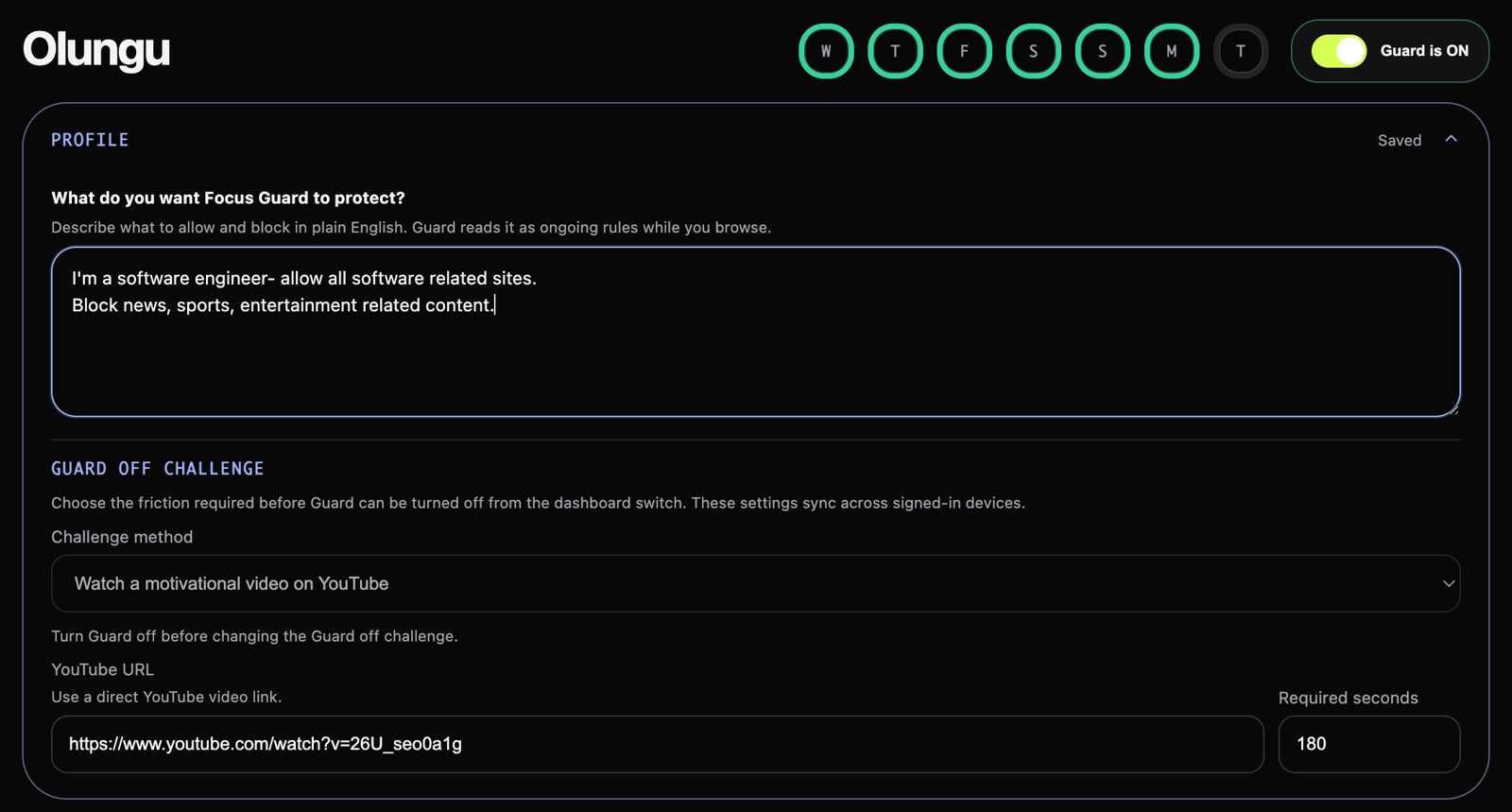
The Rabbithole Watch feature is particularly relevant for long days. You can set a time budget for domains you genuinely need but could easily overuse — think a 20-minute daily budget on a research platform. Olungu tracks your time there and shows progressive warnings at 50%, 75%, and 90% of your budget. That's the kind of gentle friction that works when your willpower is already depleted at hour ten.
For sites you genuinely can't visit right now — news feeds, social platforms — you add them to the Block List and they're gone instantly, with no AI involved and no wiggle room. The Guard Off Challenge feature adds further protection: if you try to turn off Focus Guard impulsively, you can configure it to require typing a custom sentence or watching a timed clip first, making the off-switch a deliberate act rather than a reflex.
On long days, front-load your toughest blocks with Focus Guard set to its most restrictive threshold. By hour nine, use a less aggressive setting for the lighter admin phase — your Guard Profile's task context handles the rest.
Managing Energy, Not Just Time
Time management frameworks tend to miss the underlying driver: your cognitive energy level determines what quality of work you can actually produce in any given hour. Treating all hours as equivalent is the mistake.
Food timing matters more than most people acknowledge. A heavy midday meal causes a predictable energy dip 30–60 minutes later. If you're hitting hour five of a 15-hour day, a large lunch is working against you. Smaller, protein-forward meals every few hours maintain steadier blood glucose without the crash.
Caffeine has a cutoff. Caffeine's half-life is roughly 5–6 hours, meaning a 3pm coffee is still 50% active in your system at 8–9pm. If you need to be at a reasonable level of functional sleep quality after a long day, cut caffeine by early afternoon and use movement breaks instead for the later-day energy push.
Idle detection isn't a failure — it's how the brain consolidates work. The Olungu Focus Sessions feature accounts for this: its idle detection pauses your focused-time accumulation when you step away from the keyboard, so breaks aren't counted against you. More importantly, this gives you accurate data on how much focused time you're actually accumulating versus how long you've been at the desk.
The Hard Stop and Recovery Protocol
One of the most counterintuitive things about surviving long days is that how you end them matters nearly as much as how you structure them. Going from an intense 15-hour session straight to attempting sleep doesn't work well — your nervous system is still in high-alert mode.
A 20–30 minute wind-down protocol at the end of the day is worth the time investment. Write a brief note of where each open project stands — your brain will stop trying to hold those threads open during sleep. Dim lights. No new information input for the final 45 minutes. The goal is lowering arousal, not more productivity.
The question isn't whether you can survive a 15-hour day. It's whether you can survive ten of them in a row — and that depends almost entirely on recovery quality between them.
If you're running multiple long days in sequence, the recovery between them becomes the critical variable. Research on sustained overwork suggests that without genuine recovery, cognitive performance degrades in ways that aren't apparent to the person experiencing it — you feel like you're keeping up, but error rates and poor decisions accumulate invisibly.
Plan the off-ramp from a sprint before you start it. If you know you're doing five 15-hour days for a launch, schedule a genuine recovery day after — not a "lighter" day where you still check email constantly, but a real day off.
When 15-Hour Days Become a Pattern
Occasional long days are a reality for founders, freelancers, and knowledge workers with hard deadlines. Chronic 15-hour days are a different diagnosis — they usually indicate one of three things:
- Scope and capacity mismatch — more committed to than can be delivered in normal working hours
- Distraction overhead — actual focused hours are much lower than hours at the desk would suggest
- Workflow problems — bottlenecks that multiply the time each task takes
The second one is more common than people admit. Alex Soojung-Kim Pang's research on top performers found that most people achieve only 4–5 genuinely focused hours per day regardless of how long they sit at their desk. If you're at your desk for 15 hours but your actual focused output is 5, the fix isn't endurance — it's protecting those 5 hours aggressively and being honest about what the rest of the time contains.
Tracking this honestly matters. Tools that measure focused time — not just time at computer — tend to be revealing. The gap between hours worked and hours actually productive is where most people find room to reclaim their day.
If you're working long days and losing significant time to browser drift, tab-hopping, and distraction — try Olungu free. It's a Chrome extension that blocks distracting pages based on what you're actually working on, not just a fixed list of blocked domains. Start with the free tier, set up a Guard Profile for your current project, and see how it changes the quality of your longest work sessions.
Frequently asked questions
Occasionally, for a defined short period, 15-hour days are manageable if followed by genuine recovery. Chronically — meaning weeks or months — the evidence points clearly to declining cognitive performance, elevated health risks, and compounding errors. [Research consistently shows](https://blog.rescuetime.com/how-many-hours-should-we-work/) diminishing productivity returns well before the 15-hour mark.
Structure the day into 3–4 hour blocks with real transitions rather than treating it as one continuous stretch. Front-load your most demanding cognitive work in the morning when your capacity is highest. Use environmental controls — like browser blockers — to compensate for depleted willpower in the later hours, and protect sleep quality on either side of the long day.
Most adults need 7–9 hours, and that doesn't change because work demands increased. Working 15 hours makes adequate sleep harder to achieve but more critical — sleep debt compounds fast and impairs the decision-making and creativity that make long days worth doing in the first place. Protect sleep aggressively even during sprint periods.
Common signals include declining quality of output (not just quantity), increasing error rates, difficulty making decisions that previously felt straightforward, and irritability or low mood that persists through the day. A subtler sign: if you need more hours to produce the same output, you're in a deficit cycle rather than a productive surge.
Design your environment so the default action returns you to work, not to a distraction. Block high-temptation sites proactively rather than relying on willpower later in the day. Use time budgets for sites you need but could overuse. The key insight is that resistance to distraction weakens significantly after hour six — your setup needs to compensate for that automatically rather than requiring constant active resistance.
Rarely in proportion to the hours invested. Output quality degrades across a long day, and errors made in hour twelve often create rework in hour two of the next day. The more useful frame is asking how many focused hours the 15-hour day actually contains — and whether those could be protected within a shorter, better-designed day instead.