Olungu
How to Break Up Long-Term Goals Into Smaller, Manageable Pieces
Learn how to divide ambitious long-term goals into smaller, achievable steps — with research-backed methods that build momentum without burning out.

Founder of Olungu and a software engineer with over 10 years of experience building technology products. He writes about productivity, focus, behavioral psychology, and evidence-based strategies for achieving goals and doing deep work.

Breaking a long-term goal into smaller pieces works because it makes progress visible, reduces the paralysis that comes from staring at a distant finish line, and gives your brain a steady stream of wins to stay motivated. Instead of treating a goal as one monolithic task, you map it into a sequence of concrete, time-bound sub-goals — each of which is completable in days or weeks rather than months or years.
Breaking a long-term goal into weekly or biweekly sub-goals increases goal attainment measurably — a Wharton field experiment found 7–8% more output from volunteers given specific sub-goals versus a single annual target.
Goals fail most often because they are too vague, too large for the available time frame, or disconnected from genuine motivation — not because goal-setting itself is flawed.
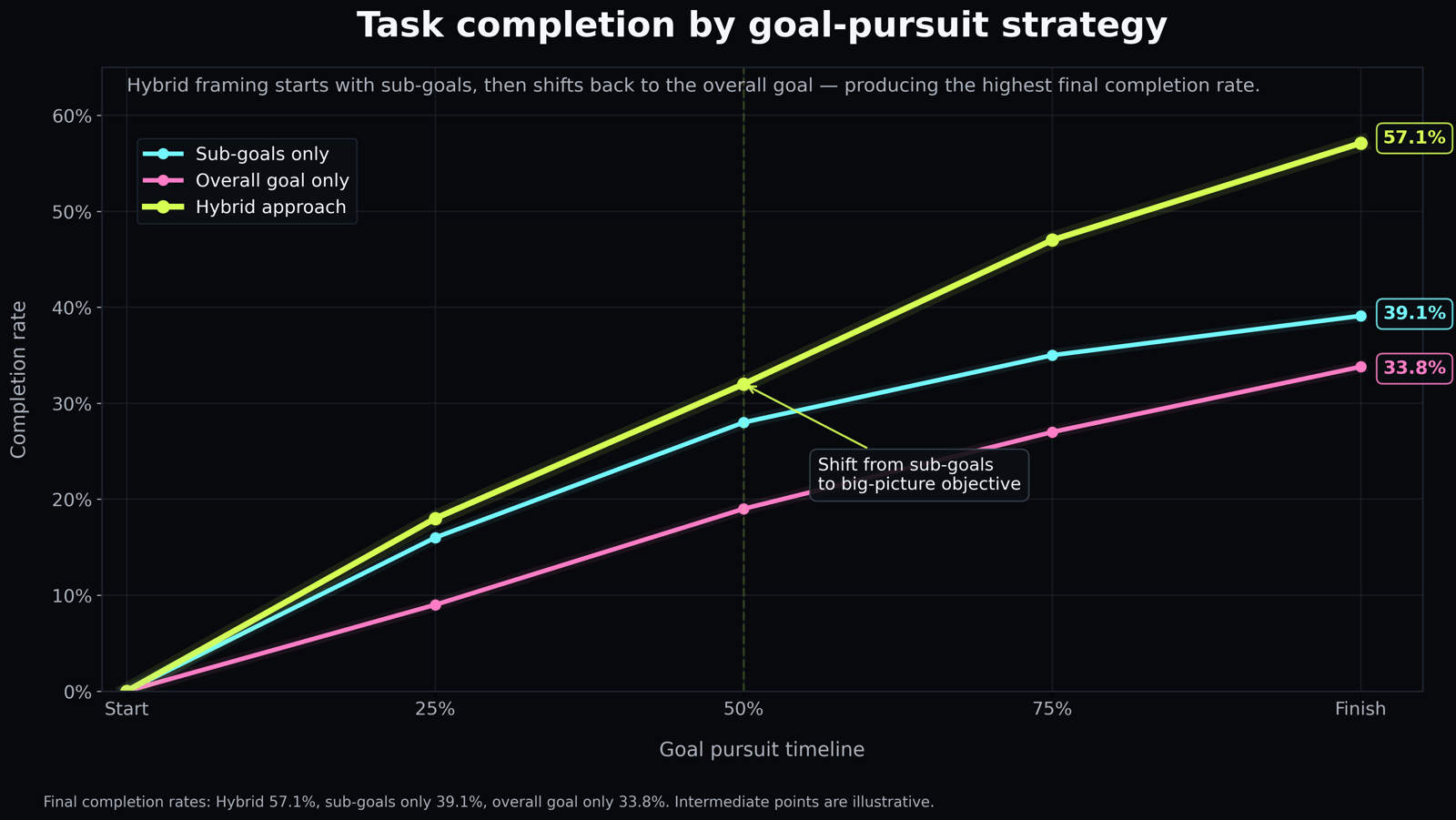
The most effective strategy combines sub-goals early in a pursuit (to build confidence) with a shift toward the big-picture goal in the final stretch (to maintain motivation).
Flexibility built into sub-goals — allowing a missed week, or using biweekly rather than daily framing — prevents the all-or-nothing abandonment that follows a single setback.
Environmental design during work sessions is an underrated factor in whether sub-goals actually get executed; removing or restricting tab drift and distraction is as important as the goal structure itself.
Why Big Goals Alone Tend to Stall
There's a simple reason ambitious goals fail so often — not because ambition is the problem, but because the goal is set at the wrong resolution. A goal like "write a book" or "get fit" offers no clear next action. You sit down on Monday morning, stare at the gap between where you are and where you want to be, and open Reddit instead.
Research from Wharton confirms the mechanism. In a field experiment with more than 9,000 crisis counseling volunteers committed to 200 hours of work per year, those given specific sub-goals (4 hours per week or 8 hours every two weeks) volunteered 7–8% more than those simply told to aim for the annual target. That 8% increase — at essentially zero cost to the organization — translated to an estimated 19,900 additional hours when projected across the full volunteer base. The goal didn't change. Only its resolution did.
A separate PwC study tracking more than 1.5 million goals across 12,000 employees found that people who set at least four daily goals per week were 34% more likely to hit their KPI targets than those who didn't. And when employees achieved at least half their daily goals, they scored meaningfully higher on reported mood — a feedback loop that matters for sustaining effort over weeks and months.
There's also a real risk of the opposite failure: goals that are too granular can remove flexibility. Wharton's Katy Milkman puts it plainly: "The smaller the goals, the less wiggle room you have to change your plans." Hourly targets start to impede, not help. The sweet spot is sub-goals that are small enough to feel achievable but spacious enough to absorb a bad day.
Four Ways to Break a Goal Down
The goal isn't to set any smaller goal — it's to decompose the right way for your specific situation. Here are four distinct approaches, each suited to a different type of problem.
1. Shrink the scope
This works when a goal is too vague to act on. The fix is narrowing it until there's no ambiguity about what "done" looks like.
- "Get healthy" → "Walk for 20 minutes three mornings a week"
- "Grow my business" → "Get 5 paying clients before end of Q2"
- "Declutter the house" → "Clear one shelf in the kitchen this weekend"
Narrower scope creates a clear target. You either hit it or you don't, and that clarity makes starting easier.
2. Pick a rest stop
For goals that are measurable and have a natural progression, identify milestones you'd pass anyway — and treat each one as its own goal. If you want to run a half-marathon but can barely run 2 miles, your first goal isn't the half-marathon. It's 30 minutes without stopping. Then 5K. Then 10K.
The workbrighter.co framework calls these "rest stops" — points already on your path that you make intentional and celebrate when you reach them. For goals where the path is less obvious (learning to write fiction, for instance), you create your own rest stops: understand story structure, annotate five books in the genre, write a short story, then attempt the novel.
3. Lower the frequency
Most habit-based goals fail because people try to go from zero to daily instantly. Going from never meditating to meditating every single day is a recipe for a two-week streak followed by guilt. Instead, commit to three times a week. When that feels routine, increase it.
Frequency-lowering gives you practice "showing up" for a habit before you scale it. The repetition itself is what matters early on — not the volume.
4. Lower the intensity
Paired with frequency, this one has a useful side effect: once you start a smaller version of a task, you often keep going. Eliza Cross describes a classic example — setting a timer for 10 minutes on a dreaded task, then finding yourself in a groove and working for 40. Writing 350 words a day instead of 750 is sustainable; and on many days, 350 becomes 600 because the friction of starting is the actual barrier, not the duration.
Combining approaches is almost always better than applying just one. Set a rest-stop milestone, then lower the intensity on the way to it. You're not cheating — you're making a complex goal navigable.
The Hybrid Strategy: Start Granular, Then Zoom Out
One non-obvious insight from Stanford GSB research is that your optimal goal framing should shift as you progress. Early on, sub-goals are reassuring — they prove the overall goal is actually doable. But late in a pursuit, those same sub-goals can make effort feel routine and uninspiring.
In one Stanford study, participants were given either sub-goals only, an overall goal only, or a hybrid. The hybrid group — sub-goals during the first half, then a shift to the big-picture target — uploaded 1,906 items. The sub-goal-only group uploaded 1,392. The overall-goal-only group: 1,268. The hybrid plan produced 57.1% completion of the final goal, versus 39.1% and 33.8% for the other two groups respectively.
Practically, this means: when you're 30% of the way to a goal, your sub-goals are your focus. When you're 70% there, shift attention to the finish line — because that's where motivation comes from in the final stretch.
Flexibility Matters as Much as Structure
Breaking goals down can backfire if the sub-goals are too rigid. The Wharton volunteer experiment found that "8 hours every two weeks" held up better over a 12-week period than "4 hours every week" — even though both add up to the same annual total. The biweekly version gave people room to compensate for a bad week without feeling like they'd failed.
This connects to research on what behavioral scientists call the "what-the-hell effect": when people miss a goal, they're prone to abandoning it entirely. Building in flexibility — a skip allowed once a month, a buffer of extra days — isn't weakness. It's inoculation against that all-or-nothing collapse.
One Thing That Kills Progress on Every Level
You can set perfectly calibrated sub-goals and still lose hours to tab drift and doomscrolling. The gap between sitting down to work and actually working is where smaller goals unravel. You open your browser to research, end up on a news site, and 40 minutes disappear. Your sub-goal was clear; your environment wasn't.
This is the underappreciated variable in goal attainment: environmental design during execution. The goals tell you what to do. Your environment determines whether you actually do it.
Olungu is a browser extension built for exactly this gap. Rather than blocking the entire internet, it evaluates each tab against your current task context — so a YouTube video about your topic stays open while an unrelated one gets blocked. You write your focus goal into the Guard Profile (e.g., "writing a 2,000-word draft on pricing strategy"), and Olungu uses that context to decide whether each URL you visit is on-task or off. A Wikipedia page about your subject: allowed. A sports scores tab: blocked. That distinction — context-aware rather than domain-blanket — means you lose access to the drift without losing the open web you need for real work.
The goals tell you what to do. Your environment determines whether you actually do it.
Features like Rabbithole Watch let you set time budgets on sites that are technically useful but easy to overuse (GitHub, for instance, can turn into a three-hour rabbit hole of interesting repos). And the Focus Sessions tracker gives you real feedback on how long you've actually been working versus how long you've been seated — which makes it much easier to set credible sub-goals next time.
Tracking and Celebrating Small Wins
None of this works if you don't close the loop. The PwC data shows that employees who publicly posted about completing a goal — or a colleague's success — were 59% more likely to record a positive mood, which compounds into better sustained performance. The mechanism is straightforward: acknowledging a win reinforces the behavior that produced it.
You don't need a system to do this. A checkbox, a note in a journal, or a brief message to someone who cares about your progress is enough. What matters is that the completion registers — that your brain gets the signal that the sub-goal was real and was met.
For longer-term goals especially, tracking serves a second purpose: it gives you data to calibrate. If you set a sub-goal of writing 400 words a day and consistently hit 250, the goal wasn't a failure — it was a measurement tool. Adjust the target and move on.
Putting It Together: A Practical Sequence
Here's a concrete way to apply these ideas to any long-term goal:
| Step | Action |
|---|---|
| 1. Define the big goal | Make it specific enough that you'd know when you've reached it |
| 2. Pick a near-term rest stop | Choose a milestone 4–8 weeks out that's visibly on the path |
| 3. Set sub-goals for that window | Weekly or biweekly targets at a frequency and intensity you can sustain *right now* |
| 4. Add flexibility | Allow one "miss" per month without penalty |
| 5. Design your environment | Remove or restrict what typically derails your focus during work time |
| 6. Track and acknowledge wins | Close the loop each time a sub-goal is met |
| 7. Shift focus as you progress | Around 60–70% completion, move your attention to the big goal |
Start this way, even if the system feels too small. Small goals compound. The volunteers who aimed for 4 hours a week didn't care less about their 200-hour target — they just had a better operating structure for reaching it.
If the environment side is the piece you want to fix first, try Olungu — a free browser extension that blocks off-task tabs based on what you're actually working on, not just a blanket domain list. Install it, write your current focus goal in the Guard Profile, and see how much cleaner your browser sessions get.
Frequently asked questions
Small enough that you could complete it in a single focused session on a busy day. A sub-goal that requires a perfect, open schedule is still too big. Wharton research suggests weekly or biweekly targets hit the right balance — granular enough to reduce procrastination, flexible enough to survive a disrupted week.
Yes. Wharton's Katy Milkman found that very granular goals (daily or hourly) reduce flexibility and increase the likelihood of abandonment after a missed target. The ideal sub-goal is small enough to feel achievable but large enough to allow for scheduling adjustments.
Stanford GSB research suggests around 60–70% completion. Early on, sub-goals reassure you that the main goal is doable. Later, when that concern fades, the big-picture target becomes more motivating — keeping you from coasting through the final stretch.
Keep it as lightweight as possible — a checkbox, a daily note, or a simple habit tracker. The point is closing the loop so your brain registers completion. Over-engineered tracking systems often become a distraction from the actual work.
Build in explicit flexibility from the start — allow one missed target per month, or use biweekly rather than weekly framing so a bad week doesn't automatically break your streak. Research on the "what-the-hell effect" shows that a single miss often leads to total abandonment, so designing for misses in advance is essential, not optional.
The PwC research tracking over 1.5 million goals found a causal (not just correlational) link between actively setting and logging goals and actual performance improvement. The act of writing a specific goal — not a vague intention — appears to be part of what makes it effective.