Olungu
Smarter Goal Setting Techniques That Actually Lead to Results
Practical goal-setting techniques that connect ambition to daily action — including how to protect the focus your goals actually require.

Founder of Olungu and a software engineer with over 10 years of experience building technology products. He writes about productivity, focus, behavioral psychology, and evidence-based strategies for achieving goals and doing deep work.

Reaching your full potential isn't about a single insight or a breakthrough moment — it's about building the conditions, habits, and structure that let you consistently do your best work over time. Goal setting is the backbone of that process, but only when it connects ambition to daily action.
Connecting goals to a deeply personal 'why' makes them significantly more durable than output-based targets alone.
Breaking ambitious goals into the smallest executable action — not just a category of effort — is what separates goals that stall from ones that move.
Consistency compounds faster than intensity: steady daily progress on a meaningful goal outperforms sporadic bursts of effort over any meaningful timeframe.
Designing your attention environment deliberately — adding friction to distractions, reducing it for focused work — is practical infrastructure for goal execution, not just self-discipline.
Tracking focused time, not just outcomes, gives you a feedback loop that is entirely within your control and directly tied to what produces results.
Why Most Goal-Setting Advice Misses the Point
There's no shortage of frameworks: SMART goals, vision boards, obituary exercises, GPA assessments. Many of them are genuinely useful. The problem tends to be that people treat goal setting as a one-time event rather than an ongoing practice — they write down what they want, feel motivated for a week, then drift back into reacting to whatever fills their screen.
The bigger gap isn't ambition. It's execution. You can have a clearly defined, meaningful mission and still lose Tuesday afternoon to a 90-minute detour through Reddit, YouTube, and news sites — not because you stopped caring, but because the browser is a distraction machine running 24/7 in the same window where you're trying to do your most important work. The environment works against the goal by default.
Goal setting and focus protection are not separate topics. They belong together, and any framework that addresses only one side is incomplete.
Start With a Real Why — Not a Generic One
The research and practitioner consensus on this is consistent: goals anchored to something emotionally meaningful are far more durable than goals based on obligation or abstract aspiration. As Jon Giglio describes from his own experience, the fuel that emotions provide can be nearly limitless — but only if you dig past the surface-level answer to find the core of your why.
A useful exercise: take your stated goal and ask "why does this matter?" several times in succession, working past the first polished answer toward something more personal and specific. "I want to write a book" tends to surface a different, stronger motivation when pushed — something like "I want to prove to myself I can finish something difficult" — which holds up under pressure because it's tied to identity, not just output.
This distinction matters practically. Identity-based goals survive bad days because the cost of quitting feels personal, not just logistical. Output-based goals are too easy to rationalize away when momentum stalls or conditions feel unfavorable. The exercise isn't magic — it's just a way of forcing yourself to articulate what's actually at stake, rather than stopping at the first answer that sounds reasonable.
If you can describe your goal's "why" in a sentence that could apply to almost anyone, it probably isn't specific enough yet. Push until the answer embarrasses you slightly — that's when it's personal enough to be durable.
Break Big Ambitions Into Executable Units
Big ambitions are genuinely useful — they set direction and keep you from optimizing for the wrong things. But they're also easy to procrastinate on indefinitely because the path forward feels unclear.
The fix is deceptively simple: work backwards. Take your destination and define the smallest next physical action. Not "work on the project" — that's not an action, it's a category. The actual action looks like: "Open the draft and write 200 words on the introduction before 10 AM."
Research summarized by BetterUp points to James Clear's observation that 1% improvements compound dramatically over time. A daily writing habit of 300 words produces a 90,000-word manuscript in a year — roughly a full book. The unit doesn't sound impressive; the accumulation does.
When setting weekly targets, design them to be slightly uncomfortable but clearly achievable. Goals that require genuine effort but remain within reach are the ones that build the consistency muscle. Goals that require heroic effort just breed avoidance.
This is also where most goal-setting systems fail people who work online. A student or freelancer sitting at a browser-based workflow has to manage not just their schedule, but their attention environment — which is actively working against them. The tab drift problem isn't a character flaw; it's an architectural problem.
Define What "On Task" Actually Means
One non-obvious insight: the people who make consistent progress toward ambitious goals tend to be very specific about what counts as work on that goal — and what doesn't.
Vague goals invite vague effort. If your goal is to "improve as a developer," almost any tech-adjacent browsing feels productive, including reading comment threads on Hacker News for an hour. If your goal is "complete the authentication module for my side project by Friday," the boundary is clear. Reading documentation? On task. Reading a retrospective post about a startup's failure? Probably not.
This precision applies to your environment, too. Tools, browser tabs, reference materials that are directly useful for today's task belong open. Everything else is a potential drain, regardless of how intellectually interesting it is.
Write your task context in one specific sentence before each work block — not "work on the project" but "finish the database schema for the user settings table." The narrower the definition, the easier it is to judge whether any given tab is helping or hurting.
Vague goals invite vague effort — precision about what counts as on-task work is what turns ambition into daily action.
Build Habits That Make Progress Automatic
Goals set direction; habits do the actual work. As geniusfood.com notes, positive actions done once in a while produce minimal results — it's turning them into habits that generates compound returns.
The practical design principle here: attach your goal-related work to an existing anchor. If you already make coffee at 8 AM, that's the trigger for 60 minutes of deep work. The habit piggybacks on an existing routine, so it requires no willpower to initiate.
Don't underestimate the friction of digital environments, though. A commitment to 60 minutes of deep work is meaningless if the browser can pull you away in 30 seconds. The habit needs an environment designed to support it — not just a time slot.
Friction works both ways. Adding friction to distractions (so they're harder to access) and removing friction from focused work (so it's easier to start) are both legitimate and effective design choices. Treating your attention environment like a workspace you actively configure — not just something that happens to you — is one of the highest-leverage moves available to knowledge workers.
Focus Protection Is Goal Execution Infrastructure
This is where the two threads — goal setting and focus protection — converge in a concrete way.
Traditional website blockers apply an all-or-nothing rule: block a domain, and it's gone. That works for obvious distractions but creates friction with the open web that modern work actually requires. A researcher who needs YouTube for tutorials, a developer who uses Stack Overflow and Reddit for technical answers, a writer who needs to access reference articles — all of them are poorly served by a crude domain blocklist.
Olungu takes a different approach. Instead of blocking domains, it evaluates what a page is actually about against your current task context. You tell it what you're working on — say, "building the authentication module for my app" — and it uses that as the lens for every URL you visit. A Stack Overflow thread about JWT tokens: relevant, let through. A Reddit thread about gaming: blocked. The same domain, YouTube, can result in a tutorial being allowed and a music video being stopped — because the page content is what matters, not just the domain name.
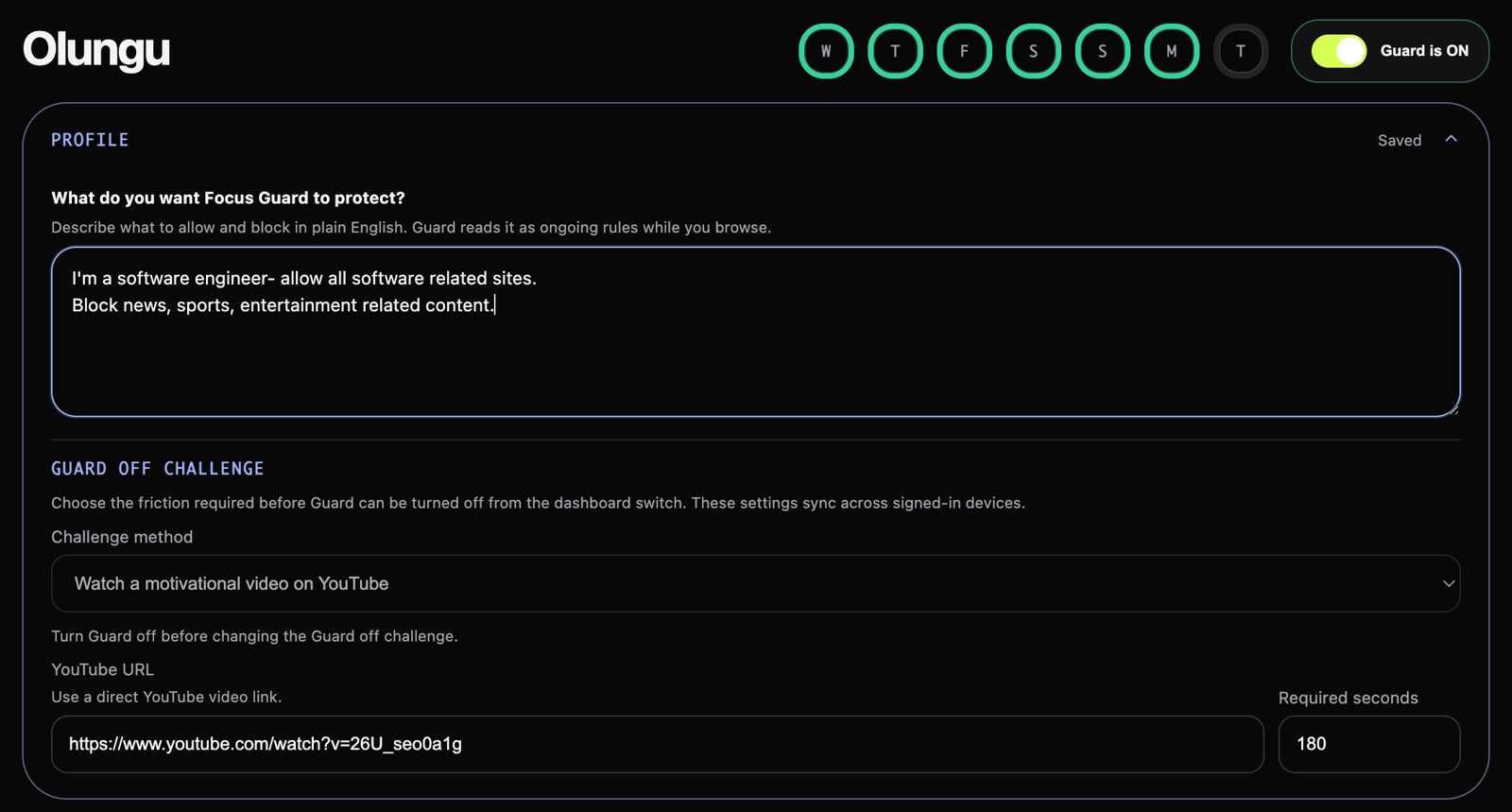
The Guard Profile in Olungu is the mechanism that makes this work. You set a general profile (standing distraction rules that always apply — block news, block social feeds) and a task context (what you're working on right now). The AI receives both when evaluating a page. For mixed-content sites like YouTube or Google Search, Olungu checks the actual URL pattern and page content rather than just the root domain — so a search query on a productive topic passes through while an unrelated one gets flagged.
This matters for goal execution because it removes the false choice between "shut off the internet" and "leave everything open." The open web you need for legitimate work stays accessible. The detours don't.
For people who find themselves toggling their blocker off the moment they want a break, Olungu's Guard Off Challenge adds intentional friction: you can configure it so that disabling protection requires you to type a specific sentence or watch a short clip first. That pause is often enough to make you realize you didn't actually need to disable it.
Rabbithole Watch adds another layer for sites that are technically on-task but easy to overuse. Set a per-site time budget — say, 15 minutes on GitHub issues per session — and Olungu shows progressive warnings at 50%, 75%, 90%, and 100% of that budget. It's not a hard block; it's visibility. And visibility, consistently applied, tends to change behavior without creating resentment.
Track Progress in Ways That Actually Motivate
Goal setting without feedback loops produces ambition without momentum. The mechanism matters: you need to see progress in a way that feels real, not just intellectually know you're moving forward.
For focus-heavy work, tracking focused time is one of the most honest measures available. It's completely within your control (unlike outcomes, which depend on external factors), it compounds visibly, and it's directly correlated with output quality for most knowledge work.
Olungu's Daily Focus Goals and streak counter reflect this logic. Set a daily target in minutes for each day of the week, watch a visual ring fill as you accumulate focused time, and see a 7-day streak build as you maintain the habit. The Value Protection feature translates that accumulated time into a monetary estimate — if your focused hour is worth a certain amount professionally, you can see the running total of what distraction blocking has preserved. It reframes what might feel like discipline into something that has a visible, tangible cost attached to losing it.
Consistency, not intensity, is what compounds — the goal isn't to work harder on any given day, it's to show up enough times that the accumulation does the heavy lifting.
Address the Internal Blockers Too
Goal-setting systems address the external structure of ambition. But Psychology Today's Robert Taibbi identifies the internal ones that often do more damage: fear of failure, need for approval, self-criticism, and measuring success only by outcome rather than by process.
These aren't soft concerns — they directly affect whether you start, continue, or quit. The practical antidote isn't positive thinking; it's structured exposure. Start small enough that fear of failure loses its grip. Celebrate process milestones, not just outcomes. Approach self-criticism the way you'd address a teammate making mistakes: with directness but without contempt.
Consistency, not intensity, is what compounds. As Jon Giglio puts it, the difference between those who achieve significant things and everyone else often comes down to showing up repeatedly — not to being more talented or more motivated at the start.
Put It Together: A Practical Starting Point
If the above feels like a lot, here's a stripped-down version to start with this week:
- Define one specific goal with a clear, verifiable outcome — not a category, a result.
- Identify your task context for each working session — what exactly are you trying to accomplish in the next 90 minutes?
- Configure your attention environment so the useful web is open and the distracting web requires effort to access.
- Set a daily focused-time target that's ambitious but realistic — 90 minutes is a good floor for knowledge work.
- Review weekly — not just what you produced, but how much uninterrupted time you actually had.
None of these steps require massive discipline to initiate. They require deliberate setup. The environment does most of the ongoing work once it's designed correctly.
Ready to pair smarter goal setting with a browser that supports your focus instead of fighting it? Try Olungu free at olungu.com — no complicated setup, just install, set your task context, and see what actually stays open.
Frequently asked questions
Working backwards from a specific outcome to identify the smallest next physical action tends to produce the most reliable results. Pair this with a consistent daily work block and an environment that reduces tab drift, and most ambitious goals become executable.
Goals set direction, but attention determines whether you actually move in that direction. Even well-defined goals stall when the digital environment constantly offers competing stimuli. Protecting focused time is part of executing goals, not separate from it.
[Research linked from Psychology Today](https://www.psychologytoday.com/gb/basics/motivation) suggests around 92% of people don't achieve their stated goals. The most common causes are goals that are too vague, lack of feedback loops, and an environment that makes distraction easier than progress.
A fixed mindset treats ability as static — either you have what it takes or you don't. A growth mindset treats ability as developable through effort and learning. In practice, this means responding to setbacks as data rather than verdicts, and prioritizing the process of improving over the outcome of any single attempt.
Designing friction into distractions rather than relying on willpower is more reliable long-term. This means configuring your browser to require deliberate effort to access distracting sites — not just intending to stay focused. Tools that evaluate page relevance against your current task context, rather than blocking whole domains, tend to work better for people who genuinely need the open web to do their jobs.
Habit research suggests consistent repetition over several weeks begins to make behaviors more automatic, but the timeline varies significantly by person and context. Setting a daily focused-time target and tracking it visibly (a streak counter, for instance) tends to accelerate habit formation because it creates a feedback signal that's immediate and concrete.